


Synthesizers used to be room-filling behemoths that required a degree in electrical engineering to operate. Modern hardware brings that same creative power into your lap, often for the price of a decent pair of headphones.
You do not need a massive studio to start crafting original sounds. The Best Synthesizers for Beginners prioritize hands-on experimentation over complex menus. Here is what you need to start your sonic journey.
Key Takeaways
- Prioritize units with dedicated knobs for each function so you can see how your adjustments shape the sound in real time.
- Choose a keyboard size based on your available workspace, but remember that extra keys are useful for playing two-handed chords.
- Look for built-in sequencers if you want to build entire songs without needing to connect a computer right away.
- Digital engines offer immense variety and stability, while analog circuits provide that warm, slightly unpredictable character.
- Verify whether the unit includes its own speaker or if you need to plan for a separate amplifier or interface.
| Essential Educational Guide |  |
How to Play the Synthesizer | Clear instructional focus | Logical learning progression | Eliminates technical confusion | View on Amazon | Read Review |
| Portable All-In-One |  |
Akai MPK Mini Play MK3 | Includes internal sounds | Compact portable design | Responsive performance pads | View on Amazon | Read Review |
| Versatile Sound Designer |  |
Arturia MiniFreak Hybrid Synthesizer | Dual sound engines | Expressive aftertouch keys | Powerful onboard sequencer | View on Amazon | Read Review |
| Compact Sonic Sculptor |  |
Behringer PHARA-O MINI Synthesizer | Highly portable size | Unique sound character | Simple operation | View on Amazon | Read Review |
| Classic Digital FM |  |
Korg Volca FM2 Synthesizer | True FM synthesis | Portable compact form | Intuitive step sequencer | View on Amazon | Read Review |
| Retro Nostalgia Tool |  |
Stylophone Pocket Synthesizer | Extremely easy to play | Unique stylus interface | Iconic retro aesthetic | View on Amazon | Read Review |
| Advanced Production Controller |  |
Akai MPK Mini Plus | Extended keyboard range | Versatile hardware connectivity | Advanced onboard sequencer | View on Amazon | Read Review |
| Experimental Texture Machine | 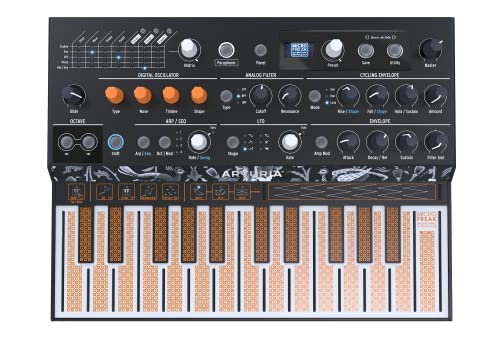 |
Arturia MicroFreak Hybrid Keyboard | Highly experimental oscillators | Polyphonic aftertouch support | Diverse analog filter | View on Amazon | Read Review |
| Minimalist Note Entry |  |
Akai LPK25 MIDI Controller | Extremely lightweight | Straightforward plug-and-play | Durable construction | View on Amazon | Read Review |
| Creative Delay Effects |  |
Korg Monotron Delay | Great sounding delay | Fun ribbon controller | Battery-powered portability | View on Amazon | Read Review |
More Details on Our Top Picks
-
How to Play the Synthesizer
If you are starting from zero, this book provides the foundational knowledge you need to understand signal flow and sound design. It acts as a clear roadmap, stripping away the technical intimidation that often keeps new players from progressing.
You will find it helpful for grasping fundamental synthesis techniques without getting lost in jargon. It is not an instrument, so you will need a keyboard to apply these lessons, but it remains the most vital tool for building your skill set.
- Type:Instructional manual
- Additional Feature:Covers sound design basics
- Additional Feature:Explains signal flow
- Additional Feature:Practical technique exercises
-
Akai MPK Mini Play MK3
This controller is a portable powerhouse for those who want to create music on the go. Since it features a built-in speaker and internal sounds, you can start jamming the moment you take it out of the box.
The dynamic keybed and MPC pads make it an excellent choice for rhythm and melody creation. Keep in mind that the speakers are quite small, so you should connect external monitors for serious mixing.
- Brand:Akai
- Type:MIDI Keyboard
- Key Count:25 keys
- Connectivity:USB MIDI
- Additional Feature:Built-in speaker system
- Additional Feature:Included sound package
- Additional Feature:Dynamic velocity-sensitive keys
-
Arturia MiniFreak Hybrid Synthesizer
You get a hybrid engine that merges digital oscillators with analog filters, providing a wide palette of textures. Its 37 keys with aftertouch allow for expressive performances that rival much larger, more expensive gear.
This is a deep instrument that grows with your abilities as you experiment with the 64-step sequencer. The interface is dense, so it may take time to memorize the menu structure for specific sound parameters.
- Brand:Arturia
- Type:Hybrid Synthesizer
- Key Count:37 keys
- Voice Count:6 voices
- Sound Engine:Digital and Analog
- Connectivity:MIDI, USB, CV
- Additional Feature:Three digital effects slots
- Additional Feature:State variable filter
- Additional Feature:Compact slim-key design
-
Behringer PHARA-O MINI Synthesizer
This is a focused instrument designed for those who want to build unique sounds with a minimal footprint. Its small frame hides a capable sound engine that excels at creating experimental textures and rhythmic noise.
It works well for users who want to add a specific analog character to their tracks without breaking the bank. Because of its size, the control layout is quite tight, which might be tricky if you have larger hands.
- Brand:Behringer
- Type:Analog Synthesizer
- Additional Feature:Compact sound design
- Additional Feature:Simplified control interface
- Additional Feature:Durable build quality
-
Korg Volca FM2 Synthesizer
If you want the iconic sounds of 80s digital synthesis, this is your entry point. It packs six voices of polyphony into a tiny box, allowing you to create complex chords and evolving sequences.
The 16-step sequencer makes it incredibly easy to build loops during live sessions. While the controls are powerful, you will need to spend time learning FM synthesis logic to get the most out of it.
- Brand:Korg
- Type:Digital Synthesizer
- Voice Count:6 voices
- Additional Feature:16-step pattern sequencer
- Additional Feature:Motion sequencing capabilities
- Additional Feature:Battery-powered operation
-
Stylophone Pocket Synthesizer
This is a quirky classic that provides instant gratification for any musician. You play it using a stylus, which creates a distinctive, lo-fi sound that has been used on countless records for decades.
It is a simple, fun instrument that requires zero technical setup. Don't expect professional-grade precision, but for pure creative play, it is unmatched in its simplicity.
- Brand:Stylophone
- Type:Analog-style Synth
- Additional Feature:Built-in speaker
- Additional Feature:Battery operated
- Additional Feature:Headphone output
-
Akai MPK Mini Plus
The addition of extended keys and a built-in sequencer makes this a professional-grade hub for your home studio. You can easily connect your other hardware gear thanks to the dedicated CV and gate connections.
This controller offers better control than the base model without sacrificing its compact nature. It is ideal for someone who wants to move beyond simple MIDI entry into full-scale composition.
- Brand:Akai
- Type:MIDI Keyboard
- Key Count:37 keys
- Connectivity:USB, MIDI, CV
- Additional Feature:Dedicated transport controls
- Additional Feature:Eight MPC drum pads
- Additional Feature:Includes software bundle
-
Arturia MicroFreak Hybrid Keyboard
The capacitive touch keyboard feels futuristic and allows for subtle performance nuances like polyphonic aftertouch. Its diverse oscillator types range from wavetable to physical modeling, making it a playground for sound designers.
It is a creative powerhouse that encourages you to step outside standard musical patterns. The unique PCB keyboard takes a moment to adjust to if you are used to traditional piano keys.
- Brand:Arturia
- Type:Hybrid Synthesizer
- Key Count:25 keys
- Sound Engine:Digital and Analog
- Connectivity:MIDI, USB, CV
- Additional Feature:Capacitive touch interface
- Additional Feature:Mod-matrix for routing
- Additional Feature:Built-in modulation sequencer
-
Akai LPK25 MIDI Controller
When you need a simple, reliable keyboard to input MIDI notes into your computer, this is the solution. It is light enough to fit in any bag, making it perfect for mobile producers.
It avoids unnecessary bells and whistles to provide a clean workflow. Because it lacks drum pads and faders, it is best paired with a computer mouse or a secondary control surface.
- Brand:Akai
- Type:MIDI Keyboard
- Key Count:25 keys
- Connectivity:USB
- Additional Feature:Built-in arpeggiator
- Additional Feature:Octave range buttons
- Additional Feature:Sustain pedal input
-
Korg Monotron Delay
This is essentially an analog effect unit that you play like a synth. Its ribbon controller allows for expressive pitch bends, and the built-in delay circuit adds a dark, swirling quality to any sound.
It is a perfect tool for adding analog grit to your existing instruments. The tiny knob controls mean it is more of a performance toy than a precision instrument.
- Brand:Korg
- Type:Analog Ribbon Synth
- Additional Feature:Space-echo style delay
- Additional Feature:Internal speaker
- Additional Feature:External audio input
Frequently Asked Questions
Do I need an external amplifier to hear my synthesizer?
Most synthesizers require an external speaker or a pair of headphones. While some portable models include integrated speakers, these are rarely high-fidelity. Investing in a decent pair of studio headphones is the smartest first move for any beginner.
Is it better to learn on a digital or analog synthesizer?
Analog synths are often better for learning because they usually have a one-knob-per-function design. This visual layout teaches you exactly how signal flow works. Digital synths are powerful, but they can hide their settings behind complex digital menus.
Can I use a synthesizer as a MIDI controller?
Yes, almost every modern synthesizer functions as a MIDI controller. You can connect it to your computer via USB to trigger virtual instruments inside your recording software. It is a dual-purpose tool that serves your studio production needs perfectly.
How many keys do I actually need to start?
A 25-key or 37-key layout is usually sufficient for learning melodies and basslines. If you intend to play two-handed piano parts, you will quickly find these compact keyboards restrictive. Aim for at least 37 keys if you want room to grow.
Will a beginner synthesizer become obsolete as I improve?
High-quality synthesizers hold their value well and remain useful in a studio for years. Even as you acquire more gear, your first synth often becomes a specialized sound source for specific textures. Do not worry about outgrowing a well-built instrument too quickly.