

The single most important factor for any wireless monitor system is signal reliability. When your audio cuts out during a performance, the entire setup loses its purpose.
Finding the Best Wireless in Ear Monitor System requires balancing your frequency needs with the interference common in crowded stages. A stable connection keeps your ears focused on the mix. Keep reading to see how these setups perform for different stage needs.
Key Takeaways
- Prioritize systems that offer multiple channels to avoid interference from other local Wi-Fi or Bluetooth devices.
- Check the operating frequency because 5.8GHz systems generally provide a clearer path than 2.4GHz in busy environments.
- Confirm the latency rating is under 10 milliseconds to ensure you hear yourself exactly when you play.
- Look for a system with a simple sync process so you can get up and running quickly before your set begins.
- Verify the battery life of the bodypack matches the total duration of your longest rehearsal or gig.
| Top Tier Performance |  |
Xvive U45 5.8GHz Monitor System | Extremely stable signal | Minimal interference | Compact hardware design | View on Amazon | Read Review |
| Sleek Professional Standard |  |
Xvive U45 Black Monitor System | Professional black aesthetic | Reliable signal strength | Simple setup procedure | View on Amazon | Read Review |
| Reliable Compact Solution | 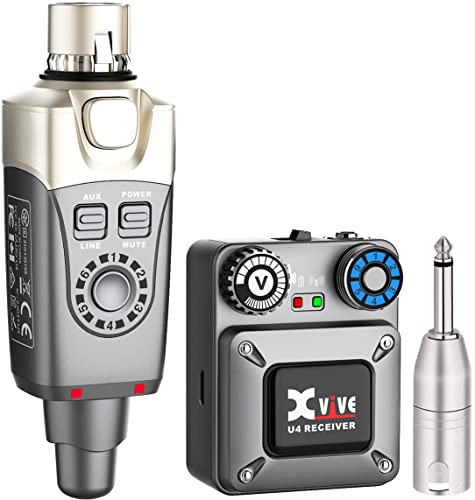 |
Xvive U4 In-Ear Monitor Set | Very portable design | Intuitive user interface | Quick setup time | View on Amazon | Read Review |
| Multi-User Band Essential |  |
Phenyx Pro 4-Channel UHF System | Supports four simultaneous users | Strong UHF signal | Professional rack mount | View on Amazon | Read Review |
| Budget Friendly Stereo |  |
LEKATO MS-02 Stereo Monitor System | True stereo sound | Fast automatic pairing | Small transmitter size | View on Amazon | Read Review |
| Quick Setup Utility |  |
JOYO JW-07 Wireless IEM System | Convenient clip design | Automatic pairing | Very portable | View on Amazon | Read Review |
More Details on Our Top Picks
-
Xvive U45 5.8GHz Monitor System
If you want the most reliable wireless monitoring, this is the one to pick. The 5.8GHz frequency band keeps your signal away from the crowded airwaves where most Wi-Fi and Bluetooth traffic lives.
It works great for live performance where stability is your highest priority. Just keep in mind that the high-frequency signal requires a relatively clear line of sight between the transmitter and the receiver to function perfectly.
- Frequency Band:5.8GHz
- Connector Type:XLR
- Additional Feature:Automatic channel scanning
- Additional Feature:Lightweight bodypack
- Additional Feature:Long battery life
-
Xvive U45 Black Monitor System
This model is effectively the same workhorse as the standard U45, just finished in a discreet black casing. It is ideal for professional musicians who need their gear to blend into a stage setup rather than stand out.
The transmitter is small enough to tuck behind a pedalboard or mixer output without causing a mess. You should know that because it uses a professional XLR connection, you will need to plan your cable routing accordingly.
- Frequency Band:5.8GHz
- Connector Type:XLR
- Additional Feature:Channel scan mode
- Additional Feature:Bodypack receiver included
- Additional Feature:Low interference operation
-
Xvive U4 In-Ear Monitor Set
Think of this as the reliable predecessor to the newer dual-band units. It offers a straightforward monitoring experience for performers who do not want to fiddle with complex menus or deep settings.
The unit is quite small, making it a perfect companion for drummers or solo artists who have limited space on their stands. Be aware that this older design does not offer the same channel scanning flexibility as the latest iterations.
- Frequency Band:2.4GHz
- Connector Type:XLR
- Additional Feature:Rechargeable battery
- Additional Feature:Simple volume control
- Additional Feature:Sturdy metal construction
-
Phenyx Pro 4-Channel UHF System
When you have a whole band to outfit, you need a system that handles multiple signals at once. This UHF-based system provides four separate channels, which is a massive upgrade over single-channel alternatives for larger groups.
The UHF transmission is like a dedicated highway for your audio, providing excellent range and clarity across a stage. It is a more permanent, rack-mount style solution rather than a portable plug-and-play device.
- Frequency Band:UHF
- System Channels:4
- Connector Type:1/4 inch
- Additional Feature:Individual volume knobs
- Additional Feature:Clear display screens
- Additional Feature:Metal chassis construction
-
LEKATO MS-02 Stereo Monitor System
If you require a true stereo monitoring experience on a budget, this is a sensible choice. It uses the 2.4GHz band to transmit audio, which is helpful for keeping your setup lightweight and easy to carry.
The auto-pairing feature makes it incredibly accessible for people who are new to wireless monitoring. Just remember that 2.4GHz can be sensitive to heavy Wi-Fi traffic, so it works best in environments where you can control the local network density.
- Frequency Band:2.4GHz
- Latency Speed:Low latency
- Additional Feature:Rechargeable beltpack
- Additional Feature:One-to-many broadcasting
- Additional Feature:Simple plug and play
-
JOYO JW-07 Wireless IEM System
This unit is designed for the performer who needs to get up and running in seconds. The clip-on receiver is a clever bit of engineering that keeps the weight off your belt if you prefer a more minimalist rig.
It is a great choice for guitarists or DJs who move around frequently and want a monitor that stays out of the way. While it is compact, it is best suited for small to medium environments where you have a clear path to the transmitter.
- Frequency Band:2.4GHz
- Additional Feature:Built-in battery
- Additional Feature:Lightweight receiver
- Additional Feature:Easy volume adjustment